Tuesday, 17 December 2013

Wild Writers Literary Festival Series – From literary journal to small press success

Here is the third installment of the Wild Writers Literary Festival Series.  Missed the previous ones?  Check them out!  #1 #2.


This panel was moderated by Carrie Snyder and included panelists Nancy Jo Cullen (Canary), Elisabeth de Mariaffi (How to Get Along with Women), Colette Maitland (Keeping the Peace) and Claire Tacon (In the Field).

CS:  I would like to hear you talk about your work process, themes and obsessions for you books.

EdM: The elaboration of my book, How to Get Along with Women, was like a moving camera shooting the same scene over and over until it changed completely.  It was written in two years and tells stories of power.  The relationships are different, but they're always about power.

NJC:  The stories in Canary were written without a thought about their connections.  They are stories about intimate relationships that veer off, about bad decisions and how they affect our lives and also about addictions.  They explore how we hold everything together through disaster.

CM:  Keeping the Peace was written over a long period of time with an arc going through the short stories.  It's as if an older version of me wrote those stories.  I had no idea what the theme was until I presented the book to an editor.  It is about trying to find peace in a family context.

CT:  In the Field circles back to family and family dynamics.  It explores what is the product of chance (the family in which one is born) and intention (decisions we take as we get older).  It explores the different experiences siblings have although they belong to the same family.

CM: The place in the story is important. I like to think of how important it is to the people who live there. I love small details.  I like to look at situations and think of all the details that should be there. If the people in the town I talk about in the book don't like it, they haven't told me. Every time I sit down to write, I reread the entire piece and edit.  I don't always know how it's going to go but details help me move the piece forward.  I don't want to work with a plot; I enjoy working with the characters.  I also like to wait until I can't not write.

NJC: The place is the West in my book, but time is more important.

CT: I grew up grounded.  My parents were refugees from Eastern Europe.  I had a family with a strong narrative about people I had no access to.  We did a lot of travelling, which is probably why my characters move around a lot and never find a home

I'm drawn to the insider vs outsider theme and I like to write about it.  I'm interested in  how the outside defines the inside.
.
CS: Could you tell us about your career development?

NJC: There is a big difference between publishing poetry and short fiction.  Poetry launches are smaller and much more private.  When publishing a work of fiction, it<s much more public and there are more event.  I felt very exposed, almost panicked.  I got more stress from all the attention.

EdM:  Being listed for the Giller Prize was positively overwhelming.  It truly was the last thing I would have expected.  I got a lot of attention which sped up the process for my next project.

CM: I have always written.  I got my first typewriter at thirteen and wrote until I got one of my stories rejected when I was in University.  Having kids also prevented me from writing.  Eventually I decided to stay at home and give myself permission to write.  It took me about two years to write this book.  One day I was on the high way and I saw this woman by the side of the road; she was the start of everything.  I needed to write her story.  I gave myself a time frame and started writing, 

I took some class but I write intuitively, it's a very organic process.  I keep on writing what I wand and on sending stuff out.

CT:  I wrote shorter fiction at first.  It was difficult to transition to longer pieces and I learned while writing.  Rejection is an amazing push.  I was first drawn to theater but rejection moved me to fiction. This time, for my second book, I'm doing it with more of a map.

NJC: Rejection happens; you have to be strong.  People will not all love what you write.  You have to believe in your vision and trust it.  You have to learn that you can survive rejection.  You just need to try to understand if there's something you need to change.

EdM: It would have been overwhelming for me to start with a novel.  The order for me is poetry-short story-novel.  You have to work quietly and experience rejection and work on yourself.  To build confidence, you have to know what your obsessions are and write about them.

NJC: Short stories and novel don't have the same structure.  Short stories are easier to navigate.

CS:  How  do you know when a piece is good to go?

CM:  I make it as good as I can and let it go.  You HAVE to send it.  Don't take rejections too personal.  If you're sick of your piece, set it aside and go back to it later.  Work on it, and send it again. 


Monday, 16 December 2013

Hipster Word of the Week – Bantling

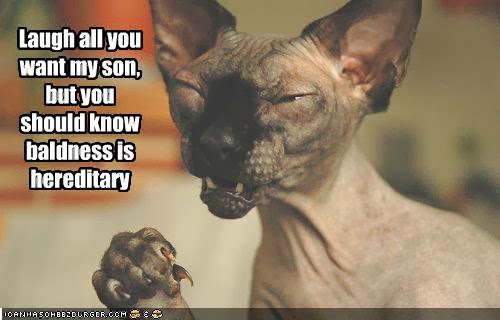
Is that a new wig?  You shouldn't try to conceil your acomia!  Anyway, more shame this week as we learn about your inner hipster's dark past.

BANTLING

n. - brat; illegitimate child.

Sometimes I wonder if I'm not Steve Job's bantling. 

Your turn!  Leave your sentence in the comment section!


Source: Luciferous logolepsy


Wednesday, 11 December 2013

Wednesday Review – Learn to Tie a Tie with the Rabbit & The Fox


I don't usually review children's books because I don't have children and thus don't usually have the opportunity to read that kind of literature.  So when author Sybrina Durant gave me the opportunity to review hers, I was delighted.

Learn to Tie a Tie with the Rabbit & the Fox is a cute story that teaches kids – you will have guessed – how to tie a tie through the Native American lore of the Rabbit and the Fox. The instruction are very well integrated to the tale, as a result, it flows naturally.  Thanks to this, I think the book has twice as much potential to attract children's attention, firstly with the engaging story (Will the rabbit escape?!) and secondly through the call to action (I want to try tying a tie! As a bonus, after reading the story to your kid, you can entertain them with the video version and teach them to sing along.

At first, I wondered if the language wasn't a bit too complex for children but then again, the colourful pictures are there to support the content.  Also, it's never too late to give children a rich vocabulary. 

With Christmas just around the corner, why not help Santa and give your little loved ones a story that will teach them something in a fun way?

Now if you'll excuse me, I'm going to go find a tie...

This is a paid review for Sybrina Durant. I am not associated with the author and will not make any commission off the sales of her book.


Tuesday, 10 December 2013

Wild Writers Literary Festival – Making the Most of your Blog

This week I bring you the second installment of the Wild Writer Literay Festival Series.  Missed the first one?  No problem! Follow the link.


"You don't need a blog..."

...is the first thing Kerry Clare, professional blogger for Canadian Books website 49th Shelf, said when she began her workshop. Which was strange, since she was there to talk about blogging. She explained. Of course, blogs are a great way to express yourself, talk about your personal experiences, network, build a platform, etc.  But despite what editors and publishers would like you to believe, blogs are not a necessity.

Clare believes that reading is a transaction between two people and proceeds to prove it by having the workshop's participants talk to their neighbors about book they're currently reading.  Immediately, the room started buzzing with energy.  And this is what blogging is about; it's about sharing your passion.

During the workshop, Clare went on to say that blogging wasn't easy and that it required commitment.  However, blogs are more personal and you should not try desperately to build a platform through it.  It's important to be yourself.  As for the content, no need to obsess over it.  A blog is a work in progress and problems can always be smoothed later.

For the authors who want a blog (or need to want one because of their editors), Clare suggests talking about the following:
  • research that didn't make it to the book
  • the characters themselves
  • places that inspired the book (with pictures!)
  • writing (from a position of authority.
 However, her most important advice was to "Blog like no one is looking."  D
o it for yourself.  If you build it, they will come.


Monday, 9 December 2013

Hipster Word of the Week – Acomia

Last week's word was so underground you probably weren't able to use it.  This week, a disaster for our male inner hipster.

ACOMIA

n. - baldness.

Have you seen Jeff latety?  His acomia has taken a turn for the worse. 

Your turn!  Leave your sentence in the comment section.


Source: Luciferous logolepsy


Thursday, 5 December 2013

Dreamers Interview Series – Parham Yazdy

This week ATUA is hosting Parham Yazdy, photographer extraordinaire.  Parham mainly does architectural photography.  You can see his stunning shots on his website.


Parham, you're the owner at Parham Yazdy Photography. Tell us a bit more about what you do. 

I do architectural photography and I'm also interested in travel, landscape and event photography. I've been in love with photography for  over 15 years.  When I finally studied commercial photography, it became my specialty.  I've been in a business for a few years.

Has photography always been a passion? Do you remember the first camera you received/bought?  
Photography became a passion for me at the first sight ! I fell in love with it when I was 14 and it forever remained my favourite hobby. My first camera belonged to my father; it was a Russian SLR camera called Zenit EM.  It was pretty old but it had a great lens and took sharp pictures!

What do you think, aside from technique and gear, makes a good photographer? 

Photography is all about seeing the details. A photographer needs to be able to convey his message through images.

Do you have a photographer you particularly admire? Why? 

My first guru in photography was one of the most famous photographer in Iran called Nasrollah Kasraian. He is an amazing photographer who has lots of travel photography books. I've always admired his pictures and his technique.

I noticed you take a lot of landscape pictures. Is portrait something you've ever considered? 

Yes and no! On the one hand, I prefer catching the moment and it works better when I take candid shots. It's amazing to see the real side of people and the result is always amazing ! On the other hand, I found out that posed portraits are not my thing. They don't feel natural to me.

What is your next goal as a photographer?

I'd like to expand my architectural photography business. I also plan on starting teaching photography.

What advice would you give to photographers and other artists trying to make a living from their art? 

Following your passion is always worth it.  Let the customers find you!

Our previous guest, Canadian author Christine Miscione would like to ask you: Two questions: How might you design a camera for someone who has no hands? And if you could invent a new type of lens that could do anything, what would it do? 

Today with digital technology it wouldn't be very complicated to do. It could be very small camera fixed on the person's glasses; the shutter could go off by saying "click!" 

As for the lens, it could be a super macro lens which could take close ups of the texture of leaves, for example. It would need to have a good depth of field and sharpness ! 

Our next featured guest is fiction author Kenneth Radu. What would you like to ask him? 

What are the steps of writing a fiction book? Do you just imagine the events as you go or do you plan first and write next ? 

You are a dreamer and would like me to interview you?  Drop me a line at stephanie.noel.writer(at)gmail(dot)com. I love meeting passionate people!

Wednesday, 4 December 2013

Review Wednesday – Catching Fire

In January I reviewed The Hunger Games.  And now, to close the year, I'm reviewing Catching Fire.


Katniss and Peeta are back in District 12 after their unorthodox victory in the 74th Hunger Games.  They now live in the Victors' village making it impossible for them to pick up their lives where they left them. While Katniss tries to make sense of her feelings for Peeta and Gale, she will have to face an entire new challenge to protect the ones she loves and her district from the Capitol.  In the growing threat of the Quarter Quell, will she be able to triumph?

What worried me the most about Catching Fire was that the love triangle would take over everything and destroy the amazing world and story Collins had created in The Hunger Games.  Luckily, unlike Clare in Clockwork Prince, she managed to keep a perfect balance between the plot and the love story.  Within the context of the novel, the protagonists' reactions and emotions are believable and in character.  I rooted for Gale after the first book, but now, I'm definitely all for Peeta!

The main story itself is amazing.  Collins build nicely on her previous novel, and we realize that elements that seemed like unimportant details – the fact that the last games were the 74th, for example – have tremendous importance for the plot and how events will unfold.  With all the twists and turns, I was shocked and surprised countless times, which is something I like in a book.  The cliff-hanger at the end is so powerful that as soon as I closed the book, I went out and bought the next one.  I can't wait to read it!

I haven't seen the movie yet, as I wanted to read the book first, but I'm very excited about it now!


ShareThis