Showing posts with label AIS. Show all posts

Thursday, 17 April 2014

Author Interview Series – Charles McGarry

This week I have the pleasure of hosting author (and ex-pastor) Charles McGarry. A few months back,  I reviewed his book, Breaking the Mold: Confessions of a Hippie Ex-Pastor, and really wanted to have him for the AIS. I'm glad he accepted my invitation.  Just like his book, his answers were short but insightful. Without further ado, Charles McGarry.

Information about the giveaway will follow the interview.


Have you always written or is it something that came later in life?

I did some writing in my early teens, but nothing of much substance.  My real drive for writing sprang up within the last few years, although I have always been a creative type.

Your book Breaking the Mold: The Confessions of a Hippie ex-Pastor is a very personal (and short) piece of non-fiction.  Is this a genre you prefer?  Are you interested in writing fiction?

My main interest is writing fiction.  While I am open to writing more non-fiction, the majority of what I write will be Fantasy fiction.

Painter Chuck Close Once said, "Inspiration is for amateurs - the rest of us just shows up and gets to work." How do you "get to work?" Do you have any ritual or specific requirements to get the juices flowing?

I like to do my writing at Starbucks.  Believe it or not, I like being in a hub of activity and distraction to get my juices flowing.

Are you working on a new book at the moment?

My current project is a book of short fantasy stories that I plan to have published by summertime.

If you could sit and have a chat with any writer that has ever lived (or is still alive,) who would it be?  What would you talk about?

J.R.R. Tolkien, no doubt about it.  I would ask what he thinks about the literary phenomenon he started.  He really is the father of modern Fantasy after all.  I would also ask his advice for writing Fantasy, specifically for creating something uniquely original in an age when fantasy literature has permeated the market.

What is the one advice you would like to share with aspiring writers?

Never let anyone tell you how hard it is to become an author, and never let anyone tell you what you can’t do. The possibilities are endless if you stay true to yourself.

Our last guest, swing dance instructor (and so much more) Owen Hortop would like to know: How do you think people find or lose faith? Is it circumstance, or do they follow internal patterns?

Some would say it’s circumstance, but I really think that circumstance only serves to clarify what a person was oblivious to before.  In my case my circumstances caused me to search deeper within myself, and I discovered that so much of what I believed and taught was so different than what I knew to be true in my gut. My circumstances set me free from my religious mold, so that I could hear what my inner self knew to be true all along about the universe.

Our next guest is Andrew Sauvageau, baritone and actor.  What would you like to ask them?

What is most challenging to you personally when preparing for a performance, and what do you do to rise to that challenge? 

GIVEAWAY

To win a copy of Charles book, leave him a question in the comment section.  Whoever asks the best question wins!  Giveaway ends on Tuesday April 22nd 11:59PM ET.  Answers to the questions as well as the winner's name will be announced on Thursday April 24th.


Thursday, 23 January 2014

Author Interview Series – T.B. Markinson

Today ATUA has the pleasure to be one of T.B. Markinson's stops on the her blog tour.  Markinson is an American expat living in England and the author of two novels.
Giveaway info will follow the interview.
Have you always known that you wanted to be a writer or did that come later in life?
In the sixth grade we had to write a short story. My teacher loved my story and wrote a small note at the top of my paper. It read: When you grow up, you should be a writer. That was it. I was hooked and wanted to write. Over the years I would jot down stories and I started at least one novel but never finished it. Life always interfered. I was working full-time and whenever I tried to take my writing to the next level, something would happen and I found myself consumed with everyday life. Then over two years ago my partner’s company asked us to move from Boston to London. Suddenly I was unemployed. The transfer was supposed to last two years and my partner and I decided that I would use the time to give writing a go. So I pulled an unfinished manuscript out of the drawer and got to work. Now the book is published and I’ve completed the second one, Marionette.


Your Goodreads profile states that you had pledged to publish before 35.  What made you want to set that age as a deadline?
I’m not sure why I selected that particular number. I was in my early 20s when I made that declaration and maybe I thought it was completely reachable. And since I was still in my 20s I may have thought 35 was old. In a few months I’ll be 40 and I no longer associate my age with being old since I still feel like I did twenty years ago. However, I have more aches and pains.
I missed my deadline by four years, but I never lost the desire to succeed. For everyone out there who has a dream of publishing, my advice is never give up. 

Marionette is your second book.  How different was it writing YA?

Marionette is the second book that I’ve published, however, it was the first novel that I wrote. I worked on the first draft back when I was in college. I pulled the original draft out of my drawer last year and even though I shredded most of it, I was able to maintain the young adult voice since I was basically a young adult when I started it. Thank goodness I kept that draft for two decades. 

Painter Chuck Close once said, "Inspiration is for amateurs - the rest of us just shows up and gets to work." How do you "get to work?" Do you have any ritual or specific requirements to get the juices flowing? 
I work from home so this can be challenging on some days since there are so many distractions, mainly my cat and dog who always want attention. My goal is to write 1000 words a day. Before I sit down to accomplish that, I like to get all of my emails answered and to take care of the other administrative details concerning my books and life. I find it’s best I do this first thing to eliminate one distraction. That way I can’t say, “Oh wait, did I answer my emails.”
Then comes the hard part. I sit at my desk, with a cup of tea (I’m addicted), and write. Some days the words flow. Other days they don’t. But it’s rare for me to stop before I reach 1000 words. And on most days, I go over my goal. The most important part is to sit down and do it. I know that sounds too easy, but that’s what it comes down to. Just write. 

Homosexuality and sexual discrimination are recurring themes in your books.  What motivates you to tackle those topics?
Both of these themes fit with the stories. I didn’t sit down to write specifically about these topics, they just happened to work for the characters in my stories. For me the most important aspect is the story.
Saying that, I do think these topics are important and should be discussed openly. Human rights should never be ignored, even though it isn’t always an easy conversation to have. 

Are you working on a new novel at the moment?  If yes, can we get a scoop?

The next book is about a woman who had everything going for her. She graduated from Harvard, had a literary agent, and a fantastic deal to write her first book. However, everything has fallen apart and she’s working at Starbucks to make ends meet. She has a crazy, but loving family and girlfriend. It’s about whether she can find her true path in life and get everything back on track.

What advice would you give to emerging authors?
Relationships are key to emerging authors. My advice would be to foster relationships now with other authors and readers. Marketing is important, however you can’t just shout from the rooftops, “Buy my book!” There are so many books out there. Readers want to connect with authors. If they don’t feel that connection then there’s a good chance they’ll buy a different book. And don’t expect instant success. It’s takes time. Don’t give up in the beginning just because it’s a lot of work. Patience is important.
Our previous featured guest Tania Mignacca wants to ask you: I read on your blog that you have self-published your first novel. What advice would you give to writers or comic artists who are looking to self-publish for the first time?

I recommend doing your homework. Two authors really helped me with my decision to self-publish. The first is David Gaughran. I recommend his books: Let’s Get Digitaland Let’s Get Visible. Also his website is a fantastic resource: http://davidgaughran.wordpress.com/ .The second person that helped was Joanna Penn. Her book: How to Market a Book is a great resource and her website is useful: http://www.thecreativepenn.com/. Both of these authors have also published fiction and the methods they describe in their books are ones that they have used.

There are a lot of companies out there who claim they can help you self-publish for a reasonable fee. Do your research so you don’t get conned by them. I hired my editor, cover designer, and book formatter. I would be careful about signing up with a company that says they will take care of all of these details for you. There’s no easy way out. It is hard work, but I find it rewarding. And don’t be afraid to reach out to other authors who have self-published. So many of them are willing to answer questions. It’s a supportive community. You may feel lonely, but if you reach out, it will help.

My question for Owen Hortop, owner and swing dance instructor at Cat's Corner, is:

What advice do you have for people with two left feet, but who aspire to become an adequate dancer? 

GIVEAWAY


For a chance to win an electronic copy of Marionette (see my review here) leave a question for T.B. Markinson's in the comment section.  Giveaway ends on Tuesday January 28th 11:59 ET.  Winner and answers to the questions will be posted on Thurday January 30th.  Good luck!

Thursday, 19 December 2013

Author Interview Series – Kenneth Radu

Today I have the pleasure of hosting fiction author Kenneth Radu.  I met Mr Radu at the first reading I event went to.  His stories were amazing.  After the reading, he was kind enough to answer my question but also to ask me a few questions about my own writing.  I feel honored that he accepted to be featured on ATUA.

 Would you say you’ve always been a writer or that it’s something that came later in life? Do you remember the first story you wrote?

Before learning how to write connected prose, I do remember imagining stories or vivid scenarios as a young child walking to and from school and during periods of play. A pretty consistent phenomenon, but not one peculiar to nascent writers as most children live as much in their imagination as they do in actuality. Why some continue beyond that age to immerse themselves in extended fabrications, or jot down notes for narratives, or create fictional people, thereby acquiring or claiming some sort of distinction by virtue of being a writer, is anybody’s guess. Once I entered secondary school writing became an integral part of my day. My first stories were written at that time, including two bloated and derivative novels before I was eighteen, plays, poems and short stories, all more or less copying the writers I was reading as an adolescent. I read omnivorously in all genres. I can’t remember the name of my first story, although one play was called The Locked Gate, a heavy-handed and implausible mix of Eugene O’Neill and Chekhovian drama. There was a coffin on stage for the duration of the performance, and the characters lamented existentially and tragically about its occupant and their own unsatisfactory lives. The play was performed on stage and entered in a local drama festival where it won a prize. I have never stopped writing since then.

At what point did you decide to make a living from your writing?

Well, like many writers I have never made a living from writing. It is something I do, but not something that has paid for my keep. There are writers who made a conscious decision to live by the pen, and have done and do so successfully. I think of Mavis Gallant or Mordecai Richler, or Charles Dickens, and various contemporary novelists and freelance journalists here and elsewhere who earn their living as writers, but their numbers are not legion. It wasn’t something I really thought about. In my last year of high school, I did make a conscious decision, however, to live a life of literature; that is to say allowing literature to help me decide what was important to me and how I would make money, if not directly through my own writing, then in a related field like teaching. 

Throughout your career, you’ve written novels, short stories and poetry.  Is there a genre that comes more naturally to you? 
Poetry has this mysterious allure for the young who almost universally write poems, usually lyrics, as if the genre itself is closer to how they feel and think. I wrote poems then and throughout most of my writing career until I stopped several years ago. I’m not sure what it means to say “a genre that comes more naturally to you,” as I believe that poetry is arguably the most “natural” of all genres, but it is not something I write anymore, finding more satisfaction in the artifice of fiction and sometimes non-fiction, including essays about art that appeals to me. As for novels and short stories, subject matter, character, situation and sense of completion determine my answer to what comes more naturally. The idea or story also determines the genre. A short story is a magnificent challenge: to achieve much in little space or run the risk of saying less than meets the eye, but the novel allows for development, expansiveness, and is more forgiving. 

And is that the genre you also prefer reading?

If I had to make a choice with a gun pointed at my head, I’d choose the short story, although I read novels and non-fiction regularly and with pleasure. By non-fiction I mean histories, biographies, essays, or creative journalism, some literary criticism, and now and then philosophy. Non-fiction is such an odd term really. Sometimes I think we should take a lesson from the French and refer to non-fiction collectively as Essais et documents, but it sounds rather too archival and technical in English. Of course, I read poetry also even though I stopped writing it. 

Are you working on a new project at the moment?  Can you give us the scoop as to what it is?
I am always working on something because writing is what I do on a daily basis. I have recently completed and revised a novel. As I write the answer this question, it is being copy-edited and prepared for forthcoming publication in 2014. 

Painter Chuck Close Once said, "Inspiration is for amateurs - the rest of us just shows up and gets to work." How do you "get to work?" Do you have any ritual or specific requirements to get the juices flowing?

I have tried to avoid writing rituals as I find them somewhat restrictive. For a while, I wrote in the morning but have broken that time pattern and now write during various periods of the day and evening. Inspiration comes and goes, if by that one means a sudden revelation or uncontrollable urge to write a poem or story. Like Chuck Close, I don’t require inspiration. I sit down and write. The act of writing inspires itself, and indeed “inspire” may be too inflated a concept, too romantic for my taste. The work is always present, always in my mind, and the passion for writing is endless. The creative process can be deeply complicated and subtle. Oh yes, often I write to music of a certain kind, and enjoy a tea break during an afternoon of writing. I don’t know if that can be considered ritualistic.

What is the one advice you would like to share with aspiring writers?

Read, read, read. Read widely, read much. 

Our previous guest, architectural photographer Parham Yazdi, would like to ask you the following question: What are the steps of writing a fiction book? Do you just imagine the events as you go or do you plan first and write next?  
If there are steps they don’t follow any logical sequence. I begin the day with breakfast and then write. Or, depending upon season and weather, go outside to putter about the gardens and write later. Other matters claim one’s attention as well. I don’t live in a vacuum or cork lined room. The ending of novel may occur to me before the middle. An idea might have been lying dormant for months, longer even, before I write it down into something resembling coherence. I don’t map out stories or novels until after the first draft which allows me to see what I’ve been doing more clearly. With essays I prefer to get a draft down quickly in one sitting, writing as many as 2000 words or more before I stop, and then let it gestate for a time. Events and characters in my fiction emerge from what I’ve already written, and not from what I have predetermined. There is no preliminary chart. A book is a major endeavour, and one always carries it in one’s head, so ideas connected with what the book or story is about arise in the course of washing dishes or baking bread or driving to an appointment. If suitable, I pursue them by writing and out of that writing session more events develop which leads to more writing, until I’ve produced a presentable draft in a week, a month, a year: however long it takes. And so it goes. 

Our next guest will be Tania Mignaca, a graphic designer who is fast becoming popular with her unofficial Montreal mascot, Ponto.  What would you like to ask her?

Looking through your online portfolio, I would ask what elements or aspects of Japanese art, traditional or modern, most influence your own work.

See a review of Kenneth Radu's lastest short story collection, Earthbound.

Are you an author? Would you like me to interview you? Drop me a line at stephanie.noel.writer@gmail.com.  It will be my pleasure to showcase your work!

Thursday, 28 November 2013

Author Interview Series – Christine Miscione – Q&A + Giveaway winner!

I caught death last week and was unable to do anything but sleep.  I'm much better now and so I give you Christine Miscione's belated Q&A and giveaway winner!


Lori Hayes asked

Do you plan on keep writing short stories or is their a novel in the making also?

For now my heart is with short fiction, but who knows what the future has in store.

Congratulations Lori!  You win a signed copy of Auxiliary Skins!  Please contact me at stephanie.noel.writer(at)gmail.com to claim your prize!

Thursday, 14 November 2013

Author Interview Series – Christine Miscione

Today ATUA is proud to host Canadian author Chrisine Miscione.  Her first book, a collection of short stories titled Auxiliary Skins, was realeased in August 2013 and has been extremely well received.  I met Christine at a book launch for Norm Sibum's The Traymore Rooms and immediately connected with her.  On top of being an accomplished writer, she's one of the sweetest persons I've ever met.  A real inspiration!

Information about the giveaway will follow the interview.

Your first book, Auxiliary Skins, just came out in August 2013 and reviews are quite positive. This is no doubt the result of a lot of hard work. How much would you say you invested in the book?

I’ve never thought about it in terms of investment. Directing my effort towards the publication of a book seemed to be a natural extension of what I was already doing. That being said, the project did coincide with my enrolment in a pretty demanding University program. There were many, many months of 4:30am alarm clocks and trying to fit as much writing/editing in as I could before my 8:00am classes. But it was exciting. Truly. And it was exactly what I always want to be doing.

 Did you write most of the short stories for the book or did you edit work that had already been published?

I imagine with most writers’ first publication – especially a publication that takes on the form of a collection – there is some digging into the past in order to compile a book that feels honest and whole. Approximately half the stories in Auxiliary Skins were written before I knew about the possibility of a collection – and almost all of these were previously unpublished. With the other stories, I knew about the collection, but wouldn’t say I wrote them for it. I wrote a bunch of stories and then chose the ones that seemed to complement and make the most sense in relation to the others.

Your prose is very poetic, with vibrant decriptions, rich alliterations and vivid mataphors. Are you a poet at heart? Have you ever considered publishing poetry?

I am not a poet, no. I have written poems, none of which I’m certain are any good. If my prose style leans towards the poetic, I think it has to do with my fascination with language (it’s thrilling!) Otherwise, I am not sure my prose has any of the same concerns as poetry.

Are you currently working on a new project? A next collection of short stories, maybe?

Yes – a new short story collection. I’m hoping to amass around twenty-five stories and then trim out roughly 1/3, always with an eye for that point at which the stories together feel like a cohesive whole.

 Painter Chuck Close Once said, "Inspiration is for amateurs - the rest of us just shows up and gets to work." How do you "get to work?" Do you have any ritual or specific requirements to get the juices flowing?

I have (unconsciously) developed a regimented writing program for myself. 7:30am wake-up. Copious green tea. Tasteless oatmeal, hardboiled egg. And words. Lots of words — writing (hopefully). I spend every morning this way, regardless of anything.

What is your definition "writer"? What does it take to be one?

This is a hard question to answer. Writer is a noun from the verb to write, so naturally a writer writes. Must write. But it’s more than that. There’s a kind of integrity and love of writing and language that a writer should have. Also, a particular way of engaging with the world. ‘Writer’, though, I’ve come to learn, takes on many different forms; it’s difficult to pin down in definition. I’ll just say that it seems the writers I most admire and who most satisfy the definition in my eyes, live and breathe their craft. Writing is them, the same way a tree is a tree or a dog is a dog. They are a writer before thought. And their end goal isn’t publication, but to simply write more.

Our previous dreamer, David Radcliffe, would like to ask you the following question:
Hardcover or paperback? Why?

Forever paperback. Paperback is for reading. Hardcover is a trophy on your bookshelf.

Our next featured guest will be Parham Yazdy, a professional photographer.  What would you like to ask him?

Two questions: How might you design a camera for someone who has no hands? And if you could invent a new type of lens that could do anything, what would it do?

GIVEAWAY

For a chance to win a signed copy of Christine Miscione's book, Auxiliary Skins, leave her a question in the comment section.  Giveaway ends on Tuesday November 19th at 11:59 ET.  The winner and the answers to the questions will be published on Thursday November 21.  The winner has to contact ATUA to claim his prize. 

Are you an author? Would you like me to interview you? Drop me a line at stephanie.noel.writer(at)gmail(dot)com.  It will be my pleasure to shocase your work!

Wednesday, 6 November 2013

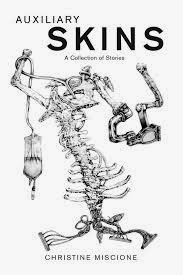
Review Wednesday – Auxiliary Skins


Auxiliary Skins, A Collection of Stories, is Canadian author Christine Miscione' first book.  However, her work has been publish in numerous literary magazines and her story "Skin, Just" – which happens to be the first story of this book –  has won the first place in the Vanderbilt/Exile Short Fiction competition in 2012.

Through her stories, Miscione explores the human body from every angle.  Proper and improper bodily functions are examined and exposed without discrimination for once every judgment and social consensus is removed, this machine is glorious in its perfectly rendered imperfection.   However, those auxiliary skins the author speaks of are not limited to the physical realm.  Rather, they tell of these imaginary walls we build around us and that provide us with auxiliary life support. Through the characters' very physical experiences of discomfort and pleasure, the reader catches a glimpse of what is hidden behind those walls which protect their true selves.  Despite their different settings, all the stories belong to this cohesive collection..

Speaking of this collection without mentioning author's amazing prose would be a crime.  Miscione has a wonderful way with words; her descriptions are so vivid that they sometimes nauseate the reader.  She has this uncanny power many great authors have to make you see exactly what she means, as if she's sharing images with the reader directly from her mind.  It's worth mentioning as well that her metaphors are dead on and that her alliterations make you want to read her work out loud.  Her scrumptious prose flirts with poetry which creates a haunting contrast with the often raw content of the stories.  Her tales stay with the reader long after they have turned the last page.

I truly enjoyed all the stories, however, I would have to say that my favourites were Skin, Just, Winter Immemorial, Herkimer and Lemon Tart.  I realize this makes for almost half the book, but it's very difficult to choose.  Do pick up a copy of Auxiliary Skins, I promise you will not be disappointed.

Want to know more about Christine Miscione?  Don't miss the interview next week!

Thursday, 10 October 2013

Author Interview Series – Brick Marlin

Today I have the pleasure of hosting horror writer Brick Marlin.  Brick has been writing since he was a child. From an early age, he was exposed to older, original horror movies and the works of  Stephen King, Clive Barker, Ray Bradbury, Kurt Vonnegut, Dean Koontz, Charles Dickens, Harper Lee, H.G. Wells, W. W. Jacobs, etc. Thus, he decided to engage himself and write horror and dark fantasy. In 2007 he decided to take a more professional approach with his work. Hence, as a member of the Horror Writers Association, already having eight books published by small presses with more in the works coming soon, nearly twenty-five short stories published, adding to the few anthologies and collaborations with other authors, Brick Marlin trudges onward, hoping to achieve more creations. Adapted from Brick's Goodreads profile

Details for the giveaway will follow the interview.


In your author profile on Goodreads, you mention that you've been writing since you were a child; do you remember the moment when you felt that this could be more than a hobby?

I think it was when I sold my first piece of short fiction to Alienskin Magazine, which is unfortunately not around anymore. I only received a five dollar check in the mail, though it gave me a great feeling knowing someone out there would actually enjoy reading my work plus paying me for it!

What drew you to horror stories? What do you enjoy the most about the genre?

I’ve always loved horror tales growing up. I can still remember watching “The Wolfman” starring Lon Chaney Jr. and “The House of Wax” with Vincent Price as well as slipping under the amazement of the movie “Westworld” starring  Yul Brynner.

In elementary school we read Edgar Allen Poe’s “A Tell Tale Heart”.  Afterward that endeavor it was all I could do to read as much horror as I could find by this master.  Later I stumbled on a great collection of short stories by Judith Stamper entitled “Tales for the Midnight Hour” by purchasing it from a book sale in the school’s library. That book still gives me chills! Of course this led to reading Stephen King, Clive Barker, Ray Bradbury, etc..

What I love most about the horror genre is not knowing what kind of terror is lying in wait in the darkness; perhaps a central processing unit programmed to cause pain and terror, sending a collage of servo cyclopean chrome spiders to traipse down your spine.

What are you working on at the moment?

I’ve been busy working on the Sectors series, continuing the saga of dark dimensional worlds involving werewolves, vampires, evil robot clowns, a creature called the Shepherd who steals souls and keeps them in glass jars in the depths of Purgatory and other bizarre oddities to fill tin he gaps.

Sectors all started on a whim, not knowing which way the tale would go, not really knowing what was going to happen, as a dark story evolved where an individual called Baron Fields controls a labyrinth of terror.

Painter Chuck Close Once said, "Inspiration is for amateurs - the rest of us just shows up and gets to work." How do you "get to work?" Do you have any ritual or specific requirements to get the juices flowing?

Oddly, the ideas I receive for creating characters and their bizarre worlds seem to come to me often; whether I’m working my day job or reading a book. Sometimes it’s all I can do to keep up, writing down the ideas which are given to me. And there are other times I blame the dreaded literary gremlins for their attempt to build a writer’s block or trying to stop transmission of any ideas sent.

What is your definition of a writer? What does it take to be one.

A lot of hard work and discipline goes into being a writer. As a lot of other writers I know say “Plant butt in the seat in front of your laptop or computer and write”. That is the truth. Veer away from Facebook and Twitter and whatever other sites you love to visit when you write. They’re distractions.

If one is willing to spend many hours inside their creation and don’t mind dealing with have a character or two whom may not act right until you threaten to eliminate him or her from the tale, then go for it!

What advice would you give to writers starting in your genre?

Read a lot and learn what the masters have done with their work. Read the books and learn the way the tales are written and how they are told. Write as much as you can and try not to let Discouragement pester you very much.

Nutritionist and previous guest Guillaume Couture would like to know: Horror novels seem to seep into your bones line after line. How do you make horror novels feel so real?

I think living behind the eyes of the characters you create helps this. I’ve always loved to write character-driven tales, bringing the reader inside the minds of the protagonist’s fears of the unknown as he or she travel into the darkness.

Our next guest is a real estate agent who left the corporate world to create his own agency. What would you like to ask him?

Why did you decide to become your own boss?

GIVEAWAY

Readers are in luck this month!  Brick will offer a copy of one of his books to two winners!  To enter, leave a question for Brick in the comment section before Tuesday Octobre 15th 11:59 ET.  The name of the winners, along with the answers to the questions, will be posted on Thursday Octobre 17th.

Read my review of Brick's book, Raising Riley.

Are you an author?  Would you like me to interview you?  Drop me a line at scbecauseican(at)gmail.com.  It will be my pleasure to showcase your work!

Thursday, 12 September 2013

Author Interview Series – Marc-André Charron + Giveaway!

Photo credit Marjorie Guindon
Today I have the great pleasure of hosting a great friend of mine, Marc-André Charron.  We know each other pretty much from birth and our parents knew each other even before that.  Well for as long as I can remember, Marc-André has always written.  Well, maybe not always, but before he could write, he was the best at making up stories for our games!

The giveaway information will follow the interview

***

Tell us a bit more about you and about what you do.

I’m a freelance actor/writer/director, mostly for the theatre world. My work touches on - but isn’t restricted to - the written word. What I mean by that is that theatre being a visual and sensual medium, I also write through images and bodies. I think they’re undistinguishable in my form of art. For many practitioners today, theatre now exceeds straight writing.

For as long as I've known you, you've always loved writing.  Did you always know you wanted to do this for a living?

I always knew I wanted to tell stories. Exactly how that was going to happen, I didn’t quite guess early on. Writing was a way telling stories, of flying away, of imagining other worlds and so on. I thought I was a writer, then I learned to be a theatre artist and actor, I did that for a while; yet writing always comes back to me like a friend I love and want to punch in the head.

Painter Chuck Close Once said, "Inspiration is for amateurs - the rest of us just shows up and gets to work." How do you "get to work?" Do you have any ritual or specific requirements to get the juices flowing?

Like most people my age who write, I seldom get paid to do so. So I have to work hard to  put the time and money aside so I can get a good chunk of writing done. If I knew how to write an hour a day and keep moving ahead, I’d love that, but I’m not wired that way. I really need a whole day, preferably more than one in a row. But other than that, no. I just get up, have a light breakfast, pour a cup of coffee and get rolling. I guess, since I take long pauses between writing sessions, I’m just anxious to get back at it.  

My girlfriend’s family own an amazing country house near Magog, that has this beautiful, long wooden table where you can sit and work. I set the dictionaries and other tools around me - drawings, other people’s writing, pictures, music - and dive in. I feel like I spend too much time on the internet, so I absolutely avoid it when working creatively. I like looking out at the birds and the trees, they make for good distractions when you’re stuck with a character or a scene. I also appreciate having something to do with my hands to shake up the cobwebs. I often have a woodworking project close by when writing, especially first drafts.

Also, my creative process is split between solo work and group development. I mostly write for plays where I know the actors and spend time creating parts of the show with them. So I’m not blind going in, I often have a good idea where things are going, or at least I can fall back on what’s been going on in the rehearsal room. But I also let myself be free of that and let new things spring to life as I go. Then it’s back at rehearsal to see if it all makes sense with the group. The process edits itself, until hopefully it all works.

What are you working on at the moment?  Do you have a play coming up on stage soon?

I’m working on a very free adaptation of the Three Musketeers by Dumas called Les Trois Mousquetaires, Plomberie - which rightly translates to Three Musketeers, Plumbing. It’s a great project, full of magical realism and rule bending. Lots of fun. It’ll be coming out next year, in the 2014-2015 season. I’m also directing it, so I’m very excited.

What is your definition of a writer?  What does it take to be one?

I like to think they are simply storytellers.  If it’s a good storyteller, we’ll listen like we’re children. And to be a good storyteller, you need empathy and curiosity. And also to work like hell.

Turlough Myers, swing dance instructor at Cat's Corner and our previous guest, left you the following question:

"I have a question for Marc-Andre! Many people tend to view theatre as a relatively open art form where just about anything is possible within the medium.  With constant new expression and new ideas involved, how important (if at all) is the preservation of “old fashioned” ideas in theatre and what place does “old fashioned” style theatre art have in our contemporary world?"

That’s a great question, I love it. I think we need to know about old fashion ideas, or else we actually don’t come up with new ones at all. If we don’t know what came before us, we may think we’re doing something radical, and then produce something that it simply in fashion. In art, I believe fashion is the opposite of innovation, because innovation is a profound thing, an immersed thing, that evolves out of what precedes it. Much of slapstick cartoon humour (of the likes of the Loony Toons of our childhood takes, for example) take root in commedia dell’art. Well if you don’t know that and want to be inspired by cartoons to make something theatrical, you’ll fumble around reinventing the wheel before realizing there’s actually something right there that exists that could help you on your quest. You can’t pretend to be inventing anything of you don’t know what’s been done. Should we be producing Shakespeare for ever? I don’t know, but we can’t ignore what it’s been and the place it held. If you want to write something as profound as the Odyssey, you might want to learn about it first.  

Our next guest is a nutritionist who left the corporate world to establish his own practice.  What would you like to ask him?

What is the scariest part of leaving a grounded, sure world and jumping into your own adventure. And how did you overcome that?

Marc-André is the author of La Descente de Jack Lebeau, Bonsai Maple Syrup, DIG, Mouving, Bouffe, «T» and Les Trois Mousquetaires, Plomberie. You can learn more about him at www.satellitetheatre.ca

GIVEAWAY 

For a change to win a copy of DIG (French version,) leave a question for Marc-André in the comment section.  Whoever asks the best question win!  You have until Sunday September 22nd 11:59 ET to enter the giveaway.  The answers to the questions along with the name of the winner will be posted on Tuesday September 24th.  Good luck!

ShareThis