Showing posts with label Wednesday review. Show all posts

Wednesday, 2 April 2014

Review Wednesday – Blood Sister


Even if you're not a History buff, chances are you've heard of Henry VIII, the infamous 16th century English king who married six times. Ever wondered what were the reasons behind his actions (other than his immediate pleasure)?  Some believe he was a bit crazy by the end (watch this awesome documentary for more on that,) but chances are his reign was greatly influence by his grandmother, Margaret Beaufort, who against all odds, managed to come out victorious of the civil war we know as the War of the Roses.  If you want to know more about that war, Marguerite Beaufort and the other women who fought to defend their right to the throne, then Blood Sisters is for you.

Gristwood starts her narrative with a rising Marguerite of Anjou and ends it with Marguerite Beaufort's death.  The book follows the chronological order of event – as is customary for Historical non-fiction – but sometimes she goes back or forth in time to illustrate the influence of a specific event.  This is done skillfully which prevents the reader from being confused.  However, the overwhelming presence of Margarets and Marguerites can be a bit confusing.  The family tree at the beginning of the book comes handy at such times. 

Not only does the author paint a vivid portrait of the different event that unfolded during the war she also has a real talent to bring those long dead historical figures to life.  She often reflects on the feelings this or that woman might have feel at different points in time.  She also uses many different sources in order to create a picture as accurate as possible of the different women (as much as the remaining historical documents allow.)

Personally, I am fascinated with English history so I really enjoyed reading this book. I have read historical non-fiction that was much more drier;  Blood Sisters doesn't read like a textbook at all.  Also, the different sections as well as the chapters' division make it easy to put down and pick up the book without losing track.  I believe this is an essential read if you want to understand the Tudor dynasty.

Although the series is not as accurate, I would recommend watching the BBC's The White Queen before reading the book.  It really helped me figure out who was who and conveniently put a face on the different names.  

Wednesday, 29 January 2014

Review Wednesday – Hellucination


In this prequel to Dialogue with the Devil, we meet a younger Stephen, who, after an eventful childhood, makes a living selling bootleg videos and is addicted to hallucinogen drugs.  Like many people, he could have gone on leading this kind of existence for the rest of his (short, no doubt) life if it were not for a sudden revelation: drugs open the door to another plane of existence, drugs can lead to God.  With his poison of predilection, Stephen sets on a quest that will give him much more than her bargained for.  

After a few amazingly well-written biographical chapters which could stand alone, Biro takes us to the heart of the matter, his drug-fueled quest for God and the encounter with the Devil that resulted. Having never taken drugs myself, it was interesting to see how they can alter the body and the mind, but what really riveted me to the pages was the author's trip to the different sin realms in Hell.  The descriptions were so vivid I sometimes had to stop reading; they made me feel queasy. The author's take on the underworld is unlike anything you've read before yet, it makes so much sense.

Hellucination is written from a much more personal point of view than Dialogue with the Devil, which makes perfect sense.  Before discussing society and what is to be found outside oneself, one needs to explore their own mind. Thus, the two volumes complete each other perfectly.  The author's views and conclusions on Hell, sins and sinner are of a remarkable lucidity.  Once again, I would urge the reader to look past their beliefs to take in the message Biro is trying to convey; it goes far beyond the empty preaching words of a religious zealot.  There is a raw truth in his words.  And on the plus side, this narrative is much more accessible than the arcane content of sacred texts.

All my praises for Dialogue with the Devil's prose, format and accessibility also apply to Hellucination.  Biro's work is a pleasure to read and I strongly suggest you read his first novel.  If you've read the second book already, you know you'll enjoy this one and if you haven't, then why not begin with the start?


Wednesday, 22 January 2014

Review Wednesday – Marionette


Paige Alexander is one of the daughters of the rich and famous Alexanders.  What looks like a blessing from the outside is actually a curse; Paige and her twin sister are estranged and their parents are nothing short of tyrannical.  After a fail suicide attempt, she starts college, away from home.  She escapes her parents only to find herself in the throes of rising anti-gay sentiment on campus.  Will she manage to find solace and triumph over those who would see her fall?

Marionette, T.B. Markinson's second novel, is a thoroughly enjoyable read.  The author has managed to create personable characters whose lives hook the reader and make them want to know more.  Each member of the little group that grows around the main character has its own personality, its own quirks which makes them very easy to picture.  The verisimilitude of Paige's inner struggle is quite impressive.  The reader is not tricked in feeling sorry for the girl, rather, it wants to see how she will handle the situation and get out of imbroglios.  I personally quite enjoyed the evolution of Paige and Liddy's (her therapist) relationship.  I believe anyone who has ever seen a psychiatrist will understand the complexity that is beautifully rendered by Markinson's words.

Speaking of which, the author's prose is easy to read without being economical.  It is easy to see that this novel had been reworked and edited numerous times achieve such a good level of writing.  I didn't notice anything specific about it (except maybe the occasional overused expression – "like a moth to a flame") which is good, because it means that it doesn't get in the way the story.  I would love to read Markinson's next novel to see how her prose evolved.  She indubitably has a lot of potential as a writer.

For the most part, the structure of the novel was good.  There were no loose ends left dangling when the conclusion was reached and the pace was skillfully set as to keep the reader wanting more.  The ending pleased me until I reached the part about her parents.  I had been wondering for a while what was going to happen to them or how they were going to get involved but what befell them felt a bit too convenient, as bit too deus ex machina.  Although I think they got what they deserved, I feel they (as well as Paige's twin sister Abbie) should have been more actively present throughout the book.  That way, their involvement wouldn't have felt so sudden.

Lastly, I can't stress enough how I enjoyed reading a story about college students who don't own a cellphone.  The story is set in 1992, yet Markinson doesn't overweight it with constant pop culture references.  It was very refreshing and, somehow, reminded me of Buffy the Vampire Slayer.  Despite its small flaws, Marionette is a great read.  I strongly recommend it.

Wednesday, 8 January 2014

Review Wednesday – Price of Justice


Detective Jason Scarsdale of Austin PD didn't think is life could get any worse after the death of his beloved wife.  He was wrong. As the high profile murder investagation he's been assigned starts to spin out of control, Scarsdale finds himself entangled in a web of deception, murder and revenge.  As the tension rises, the clock starts ticking and the investigation becomes personal, will Scarsdale manage to remain the good cop?

Price of Justice by Alan Brenham is a compelling story that kept me glued to the pages. It has all the elements of a great cop story: the good cop going through a rough time, the loyal partner, the dodgy superiors, the brilliant and attractive female cop and, of course, villains one loves to hate.  The novel is well-paced, the writing craftily creating suspense and mounting tension until the tale's denouement.  The alternation of first person naration and omniscient narration was one of the elements that contributed to create fantastic cliff-hangers.  The plot is well-structured; there are no loose ends.

Brenham managed to create characters that are well-rounded and believable.  True, it seems like every hardship is happening to Scarsdale at once but let's be honest: there are times when it seems life throws everything at you, all at once.  Plus, the author makes it work beautifully.  The reader becomes invested in the characters, wanting to know what will happen to them.  Even the villains have believable motives.  In Pride of Justice, there are no absolute evil, just human beings with personal agendas.

If characters are great, the setting is amazing.  With his economical descriptions, Brenham manages to paint a vivid picture of Austin.  The reader also can't fail to notice that the author knows his stuff when it comes to the world of law enforcement.  These two combined allowed me to see the whole story clearly in my mind's eye.

In short, Pride of Justice is a riveting novel that I wish could be made into a movie.  If that's not on the agenda, I hope to read more of Scarsdale's adventures.  This could well be the start of the great series.


Wednesday, 1 January 2014

Review Wednesday – Dialogue with the Devil


"You can call me whatever you want; a self-deluded fool, a Christian, a madman, a classic case of paranoia with schizophrenic tendencies, a visionary or even a prophet of utter magnitude that can pierce through the heart of understanding."

Stephen Biro used to be an atheist until he found God after having been deceived by the Devil.  This whole experience was recorded in his first book, Hellucination.  In Dialogue with the Devil, Stephen recounts his second encounter with the Devil, a meeting through which Satan tried to get him back on his team by revealing the truth of our world.

It would be easy to scoff at the content of this book and deem its content the rambling divagations of an addled brain.  That would be unfortunate however, and quite beside the point because Biro, whether his experience was real or pure fantasy, addresses, through the voice of the Devil, many of the plagues that have befell our society and continue to thrive thanks to our inertia.  His observations on television, the love for money, the almost religious nature of fame worship and the omnipresence of technology as a form of distraction are dead on.  In this social commentary, the author shows the readers what has been there for them to see all along with little hope of them acting upon this new knowledge.  Unfortunately, one can't help but know that he is right.  It only takes a quick look at the news and the world outside to feel that we may well be on our way to the "apocalypse" if nothing is done.  And according to Biro's Devil, it's already too late.

Dialogue with the Devil is a well-written  book with a very accessible format, which is a blessing as the content would suffer were the readers to be distracted by the writing.  The book is a bit destabilizing at first, as its content is not necessarily organized in a linear way – the Devil speaks about what he pleases in the order he pleases – but a pattern soon emerges and before long, the reader is taken with the narrative (I must confess I read it in one sitting.)  The book contains a lot of vulgar language, but such a way of speaking is to be expected from the Devil himself; it doesn't hinder the reading, quite the contrary.  Biro, as a main character, is easy to relate to, especially because of his feeling of helplessness but also because of his resilience and his strong faith.  One can't help but feel his distress as he is put through this ordeal.

Dialogue with the Devil is an excellent book, and I think that regardless of your religious beliefs, it should be added to your reading list.  It's often shocking, but we all need to be taken out of our comfort zone. 


Wednesday, 25 December 2013

Review Wednesday – A Bouquet of Dilemma


Young conservative Tobi will soon be attending university, yet she's never been in love.  That is, until she meets Richard, a dashing carefree man with a tumultuous past who is about to turn her world upside down.  Their love story is Hollywood worthy until Richard leaves for London in the hopes of bettering his situation.  Promises are exchanged but despite Tobi's efforts, it soon becomes clear that Richie boy is not coming back home.  Time is running out for our heroin; she needs to find a husband before she graduates.  With the help of her best friend Maggie, she soon finds herself in another man's arms.  Little does she know that her real troubles are only about to start.

A Bouquet of Dilemma by Tayo Emmanuel would be very similar to many romance novels were it not for its amazing setting: early 90s Nigeria.  Through Tobi's story, the reader gets to experience a culture of which very little is known, especially to North Americans.  It also it contributes to show that despite the many differences found in the political, financial and cultural context, young women have similar aspirations.  I learned many things about Nigeria in this novel, and it has made me want to learn more.

The writing style is very light and reflects well the main character's personality through her evolution.   Speaking of characters, Emmanuel has managed to create a wide range of them, each and every single one of them having its own personality.  I found all of them very credible and could not help but like them despite their flaws.  They were very human. As for setting, the author skillfully uses concise description to bring this faraway land to life in the mind of the reader.  It truly made me want to visit Nigeria.

A Bouquet of Dilemma is a light reading, one in which the reader can easily identify with the characters and intensely feel their emotions.  If you enjoy romance novels, I would strongly recommend it.  Even if it's only to find one that is set at a time when people didn't have cellphones... and in Tobi's case, not even a landline!

Wednesday, 18 December 2013

Review Wednesday – Darkness and the Radiance of Neamh


Edmund thought his problems were over when he finally died after surviving by ghastly means an apocalyptic epidemic of influenza.  He couldn't have been more wrong.  ASA, a super computer with artificial consciousness, has decided to bring him back to help her expand to all known universes.  After killing himself thirty times and being revived as many times (much to his annoyance), he decides to accept ASA's offer.  His mission will take him on an adventure fraught with danger and rich in new discoveries.  Soon, the lines between right and wrong will blur, leaving him no choice but to trust his own instincts.

Darkness and the Radiance of Neamh immediately pulled me in and didn't let go until the last page.  Griffin has a great ability to divulge just enough information to make the reader want to know more.  I often found myself thinking "One more chapter" when I was already way past my bedtime.  What's great about this book is that although I hadn't read the first one of this series, Darkness, I still didn't have any problem following the story.

What is most impressive about this novel is the setting.  Griffin juggles multiple universes with the ease of a professional juggler.  The reader moves from one to the other without ever feeling confused or lost.  The author also manages the same feat with a non-linear narrative that takes the reader back and forth in time with clarity. This could have contributed to muddying the story but Griffin pulls it off with brio.  Another great element of this book is characterization.  Edmund, Aine and Troy (more to come about him) are very lovable but Griffin also managed to create a villain – the Emissary – the reader can empathize with.  We're not dealing with a stereotypical bad guy here.  I quite liked the Emissary and look forward to see how things will play out between Edmund and him in the sequel.  (Hopefully Gridding is writing one because I need to know what's going to happen!)

Lastly, I need to talk about two things that immediately made me love this book.  The first one is Troy the android.  What I liked about him was the fact that his excuse for doing anything weird was that he was Canadian.  What was even better is that it worked.  I'm going to have to try that in the future.  The second one was the library in Eire.  What is there not to like about a library so big you might never be able to explore it completely in one lifetime.  The fact that the librarians are also the most revered and powerful people in their realm also won my heart.

Darkness and the Radiance of Neamh is a great read.  I strongly recommend it.


Wednesday, 11 December 2013

Wednesday Review – Learn to Tie a Tie with the Rabbit & The Fox


I don't usually review children's books because I don't have children and thus don't usually have the opportunity to read that kind of literature.  So when author Sybrina Durant gave me the opportunity to review hers, I was delighted.

Learn to Tie a Tie with the Rabbit & the Fox is a cute story that teaches kids – you will have guessed – how to tie a tie through the Native American lore of the Rabbit and the Fox. The instruction are very well integrated to the tale, as a result, it flows naturally.  Thanks to this, I think the book has twice as much potential to attract children's attention, firstly with the engaging story (Will the rabbit escape?!) and secondly through the call to action (I want to try tying a tie! As a bonus, after reading the story to your kid, you can entertain them with the video version and teach them to sing along.

At first, I wondered if the language wasn't a bit too complex for children but then again, the colourful pictures are there to support the content.  Also, it's never too late to give children a rich vocabulary. 

With Christmas just around the corner, why not help Santa and give your little loved ones a story that will teach them something in a fun way?

Now if you'll excuse me, I'm going to go find a tie...

This is a paid review for Sybrina Durant. I am not associated with the author and will not make any commission off the sales of her book.


Wednesday, 4 December 2013

Review Wednesday – Catching Fire

In January I reviewed The Hunger Games.  And now, to close the year, I'm reviewing Catching Fire.


Katniss and Peeta are back in District 12 after their unorthodox victory in the 74th Hunger Games.  They now live in the Victors' village making it impossible for them to pick up their lives where they left them. While Katniss tries to make sense of her feelings for Peeta and Gale, she will have to face an entire new challenge to protect the ones she loves and her district from the Capitol.  In the growing threat of the Quarter Quell, will she be able to triumph?

What worried me the most about Catching Fire was that the love triangle would take over everything and destroy the amazing world and story Collins had created in The Hunger Games.  Luckily, unlike Clare in Clockwork Prince, she managed to keep a perfect balance between the plot and the love story.  Within the context of the novel, the protagonists' reactions and emotions are believable and in character.  I rooted for Gale after the first book, but now, I'm definitely all for Peeta!

The main story itself is amazing.  Collins build nicely on her previous novel, and we realize that elements that seemed like unimportant details – the fact that the last games were the 74th, for example – have tremendous importance for the plot and how events will unfold.  With all the twists and turns, I was shocked and surprised countless times, which is something I like in a book.  The cliff-hanger at the end is so powerful that as soon as I closed the book, I went out and bought the next one.  I can't wait to read it!

I haven't seen the movie yet, as I wanted to read the book first, but I'm very excited about it now!


Wednesday, 27 November 2013

Review Wednesday – In Falling Snow


Iris is peacefully living the end of her days in Paddington Australia with her daughter and grand-children when she receives a letter from the past.  Her friend Violet, to whom she hasn't spoken in decades, is inviting her to Royaumont, France, to commemorate the old abbeye they turned into a hospital during WWI.  From this moment, we take an erratic trip to the past, voyagaging through Iris's failing memory.

In Falling Snow is the first international publication of Australian best-seller Mary Rose MacColl and what a novel it is.  From the moment I picked it up, I couldn't put it down.  I have a soft spot for wartime stories (and historical fiction in general), especially WWI tales but what makes this book special is that it doesn't concentrate on the conflict itself but on the women and the part they played in it.  We are reminded of the struggle of women who, even while they were trying to give significant help and play their part, we're underestimated and disrespected because of their sex.  Even though this is fiction, it brings an entirely different dimension the events we know from History class.  

However, the story doesn't only happen in the distant past, it also covers the present, the Australia of the seventies.  Through Grace's story, MacColl shows that despite the improvements, women are still struggling to take their rightful place in society. Not to worry, this is far from a militant feminism book.

 Aside from the extraordinary characters, what I really enjoyed from this novel is the narrative structure.  Iris is an old woman and so her memory is failing her.  She loses sense of time and place, can't recall recent event but remembers those of the past perfectly.  MacColl took advantage of this to tell her story in a non-linear way.  We constantly move back and forth in Iris's past without ever feeling confused.  To emphasis this, she intercuts Iris`s narrative with Grace's, which is clear and linear.  The structure is nothing short of brilliant.

Lastly, the ending!  I don't want to reveal anything but I have to say that it surprised me a lot.  It even brought tears to my eyes, which is a feat– the other book to have ever done so is Love in the Time of Cholera.  Just by creating that twist at the end, MacColl made her novel a hundred more times better. 

I strongly recommend this book!


Wednesday, 13 November 2013

Review Wednesday – Breaking the Mold: Confessions of a Hippie ex-Pastor


Meet Charles McGarry, an ex-pastor with very interesting world views (hence the "ex"!),  In his short essay – a mere 50 pages or so – he shares with the reader everything he's come to discover is wrong about the Church (not to be confused with Faith!) and offers viable alternatives to make this world a better place.  The best part in all this is that The Confessions of a Hipie ex-Pastor is accessible to everyone, believer or not.

I have to say that when I saw the title of the book, I was a bit put off.  I am weary of non-fiction books where the name of God is constantly branshished as the solution to all of mankind's problems.  This book, however, was not one of them, and I am glad I didn't let the title deter me.  McGarry's thoughts are extremely well structured.  His references to pop culture (who would have thought God and the Matrix could coexist on the same page?) lighten a topic that could have been much more arid.   To boot, his personnal stories help the reader connect with his ideas, which are very progressive.

Speaking of those, what are the main ideas in this essay? McGarry addresses first and foremost the very delicate topic of the Church as a financial institution.  He explains how, in his opinion, this has put Faith on the back burner in favour of a business Church, catering less and less to the needs of those it was supposed to help in the first place.  Then, he addresses the close affiliation of Church and State, underlining the pernicious consequences this has brought about.  Faced with a growing obese American population (which he partially links to evangelical potlucks!), he believes it's aboud time for his fellow countrymen to wake up and take the green shift, not only in terms of nutrition and well-being, but also in terms of the environment as a whole.  He encourages the readers to take action to proctect the planet.  

Through all these topics, there's a constant theme: breaking the mold.  McGarry is clear on this topic; everyone is different and has different needs.  As human beings, we should be able to questions and analyze the dogmas passed down to us by Church, society and even our families, in order to be our true selves.  This way, we may achieve much more as individuals and thus contribute to society.

Lastly, I would like to add that McGarry's prose is a delight.  It is simple and straight to the point.  It doesn't hinder the reading, thus allowing the message to be conveyed with all its force.  This little book is a gem.  Take a moment and read it. 

Wednesday, 6 November 2013

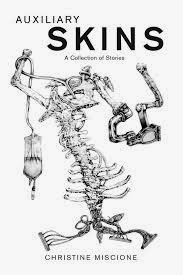
Review Wednesday – Auxiliary Skins


Auxiliary Skins, A Collection of Stories, is Canadian author Christine Miscione' first book.  However, her work has been publish in numerous literary magazines and her story "Skin, Just" – which happens to be the first story of this book –  has won the first place in the Vanderbilt/Exile Short Fiction competition in 2012.

Through her stories, Miscione explores the human body from every angle.  Proper and improper bodily functions are examined and exposed without discrimination for once every judgment and social consensus is removed, this machine is glorious in its perfectly rendered imperfection.   However, those auxiliary skins the author speaks of are not limited to the physical realm.  Rather, they tell of these imaginary walls we build around us and that provide us with auxiliary life support. Through the characters' very physical experiences of discomfort and pleasure, the reader catches a glimpse of what is hidden behind those walls which protect their true selves.  Despite their different settings, all the stories belong to this cohesive collection..

Speaking of this collection without mentioning author's amazing prose would be a crime.  Miscione has a wonderful way with words; her descriptions are so vivid that they sometimes nauseate the reader.  She has this uncanny power many great authors have to make you see exactly what she means, as if she's sharing images with the reader directly from her mind.  It's worth mentioning as well that her metaphors are dead on and that her alliterations make you want to read her work out loud.  Her scrumptious prose flirts with poetry which creates a haunting contrast with the often raw content of the stories.  Her tales stay with the reader long after they have turned the last page.

I truly enjoyed all the stories, however, I would have to say that my favourites were Skin, Just, Winter Immemorial, Herkimer and Lemon Tart.  I realize this makes for almost half the book, but it's very difficult to choose.  Do pick up a copy of Auxiliary Skins, I promise you will not be disappointed.

Want to know more about Christine Miscione?  Don't miss the interview next week!

Wednesday, 30 October 2013

Wednesday Review – The Cuckoo's Calling

World famous model Lula Landry has fallen to her death from the balcony of her third floor luxury apartment.  Although the incident is considered as a suicide, her brother, John Bristow, is convinced she was pushed.  To investigate, he hires ex-military and now private eye, Cormoran Strike.  Strike takes on the case, not certain if he'll prove Landry was killed or that Bristow is just a deluded grief-stricken man.

The Cuckoo's Calling created a lot of ripples when it was reavealed that Robert Robert Galbraith is in fact J. K. Rowling.  Although she was angry that her pseudonym was discovered, there is no doubt the extra publicity was welcome.  I made a point of not peeking at my HP books before reading it, in order to give a fair review.

Strike's investigation spans over 455 pages and is meticulously constructed.  Every detail connects, every piece and bit has meaning to the story.  Immediacy is created through the numerous people the detective interviews.  As he moves up in the layers of society of Lula's entourage, tension is built and the reader can tell they are getting closer to the puzzle's answer. Narration is done through Robin, Strike's temporary secretary, as well as through Strike himself.  The transitions are clear and well done.  However, the reader gets the feeling, in the first chapter, that Robin will be the main character, which is not the case. 

Once again, Rowling manages to create believable characters with very different personalities.  She sometimes flirts with clichés but just enough to convey a clear image of the protagonists. Strike is a lovable character who wins the reader over right away.  The quality of the author's prose, excellent as usual, contributes to it.

One thing that disappointed me in this book is the identity of the killer.  I found it rather anti-climatic and, to be quite honest, I had a good idea of who it was before I even reached then end.  I would have liked to be a bit more surprised.  Speaking of the end, this book took me forever to finish.  Somehow, The Cuckoo's Calling didn't turn out to be the page turner I expected it to be. 

Fans of Harry Potter should approach Rowling's last book with an open mind.  There is much to enjoy, but there is no magic, just harsh reality, which the author describes perfectly.

September selection of a ABCC


Wednesday, 9 October 2013

Review Wednesday – Raising Riley


Raising Riley is the story of Riley Lewis, a fifth grader victim of abuse from his dad and school bullies.  Nothing we haven't heard before, you may think, but Riley's problems are far from ordinary. There is something living in his closet. An otherworldly creature with piercing red eyes that is slowly, but surely taking over him.

Brick Marlin's novella takes the reader back to a time when children didn't have smart phone and spent their days playing outside.  The format of the book makes it seem like it's a book for kids  (relatively short, children as main characters) but the setting itself appeals to people born in the 80s.  I like to think of it as a children story for adults.

Although Riley is the main character, it was his father, Edward, that stirred the most emotion in me.  I hated the man and really wanted him to suffer at some point in the story.  The protagonist was also well portrayed, forgetting his chores like any 10 year old boy, despite the fact that he knew that it would get him in trouble.

Marlin's writes horror and there is no doubt that the creature in the closet belonged to the genre, but for me, the real horror was the abuse Riley was victim of.  the author really managed to depict the flawed logic of a violent parent.

Although this is already a fairly short novella, I think the content could be consensed into a great short story.

View my interview with Brick Marlin.
 

Wednesday, 2 October 2013

Review Wednesday – Announcement


We interrupt this program to bring you special announcements.

ONE

Are you an author?  Would you like to see your book reviewed on ATUA? I am currently accepting book submissions for this column and would be delighted to review your book.  I accept both paper and electronic formats.  Get in touch with me at scbecauseican(at)gmail.com for more info. 

Are you a reader?  I accept book review suggestions as well.  Drop me a line!

TWO

With a new review column in the making (coming soon!), ATUA is currently looking for avid readers to contribute to the Review Wednesday column.  We can discuss your schedule and discuss how often you can write for ATUA (maximum contribution will be twice a month, minimum once every other month for at least six months.)  Get in touch with me at scbecauseican(at)gmail.com.

The usual programmation of Review Wednesday will resume on October 9th.  In the meantime, click here to read previous reviews.

Wednesday, 25 September 2013

Review Wednesday – The Infernal Devices – Clockwork Princess


Clockwork Princess is the last volume of the Infernal Devices series by Cassandra Clare.  If you haven't read Clockwork Angel and Clockwork Prince you might not want to read my review as it contains spoilers.


The book opens a few months after the last events of Clockwork Prince.  We find Tessa and Jem engaged,  Will, his curse lifted, madly in love with Tessa and Gideon Lightwood living at the Institute.  The peace is immediately disturbed by Gabriel Lightwood's call for help; Benedict Lightwood, now a gigantic demonic worm, is terrorizing Lightwood manor.  The Shadowhunters fly to the rescue.This first battle start the chain of event that will eventually lead them to Mortmain and his evil plans.

Despite the combat at Lighwood mansion at the begining of the book, the first half of it is very much about the love triangle and Jem's slow death.  Suddenly, the novel fully becomes a teen love story with much ansgt, sacrifice and pain.  It drags on for a few hundred pages and robs the the novel of its usual fast pace.  Finally, when the main action begins, Clare goes back to her usual rythm but even after what should be the end of the story, she goes back to describing Will's courtship of Tessa. This does not take into account the two other love stories that add their weight to the narrative.

At this point in the series, the readers are well aware that Jem is half-Chinese and that Will is Welsh.  Yet, with Tessa now able to understand a little Chinese and Cecily (Will's sister) living at the institute, the reader is constantly overwhelmed by an unnecessary number of Chinese and Welsh dialogue lines, most of which are not translated.  It feels like the author is trying to show off her language skills and it hinders the reading.

Despite all this, Clare does tie the whole story together and there are no loose ends.  There are surprises and unexpected turns that delight the reader.  The author also manages to create interest for the following series, The Mortal Instruments, with an open ending.  

As a whole, I feel The Infernal Devices series has a promising start but loses its strenght and momentum as the love story develops to become the central element of plot.  I still recommend it; Clare's prose is, in general, a delight to read and improves with each volume.  However, the reader should be aware that the series is mainly an angsty love story and that the world Shadowhunter comes second.

Wednesday, 18 September 2013

Review Wednesday – Second Coming


Set in New York's undergound world, Second Coming follows the tribulations of Jesus Hollywood, Cowbow Rodeo, Carolina Skye and Lola Plum.  The bigger than life characters tackle fundamental problems that have the power to change their life and who they are, forever.

Shannon Noelle Long's first full-lenght is a fast paced-staccato of events that the reader can't help see as a movie in their heads.  The stories in themselves are mundane, but their treatement by the author is far from ordinary.  Through the unsual setting and the delighfully cliché characters, she bring the tale to life in full technicolor.

Long has crafted perfect names for her characters, each plainly defining the archetypes they represent.  From the start, the reader knows who he's dealing with and this allows the author to skip lenghty descriptions.  She always uses their full names and, although it could be annoying in another context, in Second Coming, it feels right, even necessary.  It reinforces the idea that these people are the epitomes of the clichés they are meant to embody.

Then, as soon as the reader feels comfortable, Long works to completely destroy the clichés by throwing her characters in situations at the antipodes of what you would expect them to deal with. The player Jesus Hollywood discovers his homosexuality, Cowboy Rodeo, the epitome of masculinity acts shy, Carolina Skye the genious photographer who could get anyone she wants, shows insecurity and Lola Plum, escort extraordinaire,  debunks the myth of the junkie prostitute and reveals a woman of great lucidity.

Of all the protagonists, Lola Plum is the one whose developement is the most subtle.  The story ends with an opening that leaves us with the feeling that she'll be alright. She was my favourite character.  Her glamour, her complete honesty about her reality and the illusion that what you see is what you get hide a heavy past.  She's the most scarred of them all and  her character was the most developped.

Althought we follow all the characters throughout the book, Second Coming is divided in three parts, the first one talking mainly of Jesus Hollywood and Lazarus, the second being about Cowboy Rodeo and Carolina Skye and the last delving into Lola Plum's secrets.


Second coming is a thoroughly enjoyable read and I look forward to reading more of Shannon Noelle Long.

***

You're an author and would like me to review your book?  Drop me a line at scbecauseican(at)gmail(dot)com and it will be my pleasure to showcase your work!

Wednesday, 11 September 2013

Review Wednesday – Caleb's Crossing


Caleb's crossing by Geraldine Brooke is the story of Caleb, the first Native American graduate of Harvard College.  Through the eyes of Bethia, daughter of the minister of Great Harbour (Martha's Vineyard,) we follow the lives of these two young souls as they struggle to reconcile diametrically opposed faiths. The tale is loosely inspired on historic events.

Although Bethia is the one who initiates Caleb's crossing to the christian faith, somehow, the title doesn't match the content.  Their stories do overlaps, but the book mostly tells of her life, not his.  The difficulty of creating a tale from the boy's point of view is understandable (lack of historical evidence being one of the main obstacle that comes to mind,) but he should still have been the main character, not Bethia.  This doesn't mean it isn't a great story, just that it isn't the one the reader expects. 

Brook's characters are well fleshed with distinct realistic personality.  She skillfully uses of the context of the extremely puritan American colonies to bring the protagonists to life.  Bethia's inner struggles make her a great character against which to pitch Caleb's certainties.  As their lives progress, it's the weights shift in the balance, the former gaining in peace and the latter sinking deeper in incertitude.

Religion plays an important part in the story, as it dictates most of Bethia's action and reaction.  The book itself reminds the reader of the Fall of man, the heroine paying for her sins as she befriends the young Wampanoag and explores his faith with too much curiosity.  It seems that, despite her happiness, she keeps on paying her entire life for the errors of her innocent age.

I read Caleb's Crossing for the Atwater Library Bookclub and it definitely was a read outside my comfort zone.  I usually enjoy historical fiction, but I tend to avoid religiously charged books as the subject matter hinders my reading (to be entirely honest, it really annoys me.)  Although it was in context, it still took me a few chapters to adjust the the religious zeal that Bethia evolved in.  However, as the book progressed, I was reminded of how lucky I am, as a woman, to be able to make my own choices and choose to get an education if I wish to.  Bethia is truly revolutionary in that sense.  She takes control of her own destiny, a pioneer in her times.  Once again, this shows how much more the story is hers and not Caleb's.The characters are very well-fleshed.  We can't help but be annoyed by Makepeace and be fond of Caleb.  The religious view of Bethia annoyed me greatly, proof that the character was very well built.

Despite the somewhat misleading title, I would recommend Caleb's Crossing.

Wednesday, 4 September 2013

Review Wednesday – Fragile Things


Fragile Things by Neil Gaiman is a short story collection, most of which had previously been published in different literary magazines and anthologies.

Judging from the small summaries of each tale in the introduction, the stories don't seem to have much in common. However, as each of them unfolds, a sense of wholeness emerges. All the characters share, to some extent, some fantastic/supernatural elements, whether in a traditional or a psychological way. They are all monsters, one way or another, trying to achieve a goal. At times, their purpose is clear, at others, they follow the path blindly. Regardless, when all is said and done, the reader is left with the feeling that she witnessed something mystical, even sacred.

Neil Gaiman truly has a gift to create universes in the span of a few lines, thus sending a knowledgeable reader directly into fast paced action. He is at home with different genres, jumping from allegorical tales to realistic and harsh stories of cold-blooded murder. Rather than clash, the different styles create an enjoyable rhythm that keeps boredom at bay. 

 I took a lot of pleasure in reading all the stories but if I had to pick the best one, I'd choose Other people, Keepsakes and Treasures as well as The Monarch of the Glen. The ending of the first one totally threw me off. I really wasn't expecting it. As for the other two, I like the fact that they're connected. If was fun to see the same characters come back for one last act. I will also mention Sunbird because it bears similarities with The Gourmet Club by Junichiro Tanizaki. Both story share the same stasis: a dining club that has run out of things to eat, however they end in completely different ways. As for the poetry, The Day the Saucers Came is undeniably my favourite. The clever use of repetition and humour make the peace quite enjoyable. 

This was my first Gaiman ever and I am looking forward to read more of his stories. I was already a fan of the man for his Make Good Art speech and am glad to say that I can extend this love to his work as well.

Wednesday, 28 August 2013

Review Wednesday – The Time Traveller's Guide to Elizabethan England

The past is a foreign country: this is your guidebook.


If you were to visit Elizabethan England, where would you sleep?  What would you eat?  Would you know how to be polite?  How would you communicate with the locals?  Ian Mortimer's The Time Traveller's Guide to Elizabethan England answers all these questions and many more.

I'm a big history geek.  I love learning about the past customs and practices of bygone times.  I find it fascinating to see that, despite the centuries separating us, people living in distant eras were oftentimes very similar to us.  And, a lot of times, very different!  The difficulty of this kind of interest is that many history books are written in a heavy style that does not encourage reading them for the sheer pleasure of learning. However, it's not the case with this amazing work.  Mortimer uses the perfect balance of humor and historical fact to make the book feel like a real guidebook. The style is rich, yet the book is very accessible. You almost find yourself starting to make plans to travel to this fascinating time in history.

Another great aspect of Mortimer's work is that it debunks many myths and misconceptions about this period in history.  It shows that the Golden age, like any other era, also had its dark side. Furthermore, since this is a guide intended for the modern traveller, the author constantly makes parallels with the readers and the people of the period, which helps seeing history from a much more personal point of view.

The Time Traveler's Guide is divided into twelve general chapters, ranging from Religion to What to wear, and, let's not forget the very important, What to eat and drink.  Each of them is then subdivided into numerous sections, each covering in more details a facet of the main topic.  The bite-size information makes it very easy to put down and pick up at any given time. This format also makes it the perfect reference for anyone wishing to write a novel or short story set in Elizabethan England.

This is the second historical travelling guide written by Mortimer, the first one being The Time Traveller's Guide to Medieval England (which I also own and intend to read), and I really hope it won't be the last.  I'm all in favor of a Time Traveller's Guide to Victorian England.


ShareThis